Real vs AI Video: What’s the difference?



The line between real videos and AI videos is getting blurry. Many people are now asking: Can I actually tell the difference?
A real video is captured with a camera. It shows real people, real places, and real events.
An AI video is made by computer software. It creates clips that look real but are not.
The problem is that AI videos are so close to real ones that even smart viewers get confused. This is why knowing the difference is very important today.
In this blog, we will cover the basics of real vs AI video, show the key differences, and give you a fun AI vs Real Video test. This will help you stay alert, avoid fake content, and understand how AI is changing the way we watch videos.
What is a Real Video?
A real video is a video recorded with a camera that captures actual people, places, and events happening in real life. It is not made or generated by artificial intelligence or computer software.
Making a real video is a hands-on process. The process begins with a concept or a script, followed by pre-production planning like location scouting and casting. During production, a crew will shoot the scenes on set or on location.
Finally, during post-production, the raw footage will be edited, sound will be added, color grading will happen, and visual effects will be added. Every frame of a real video is a physical moment that was captured in reality.
What is an AI Video?
An AI video is a video created by artificial intelligence. It can be made from scratch or by using an existing video as the base. AI then edits or changes the clip through computer tools.
The process works by generating new footage from text or visual prompts. It can also improve existing videos with automatic edits and effects.
This makes it possible to create professional-quality videos quickly. It also saves cost and time compared to traditional video editing.
Real vs AI Video: Key Differences Explained
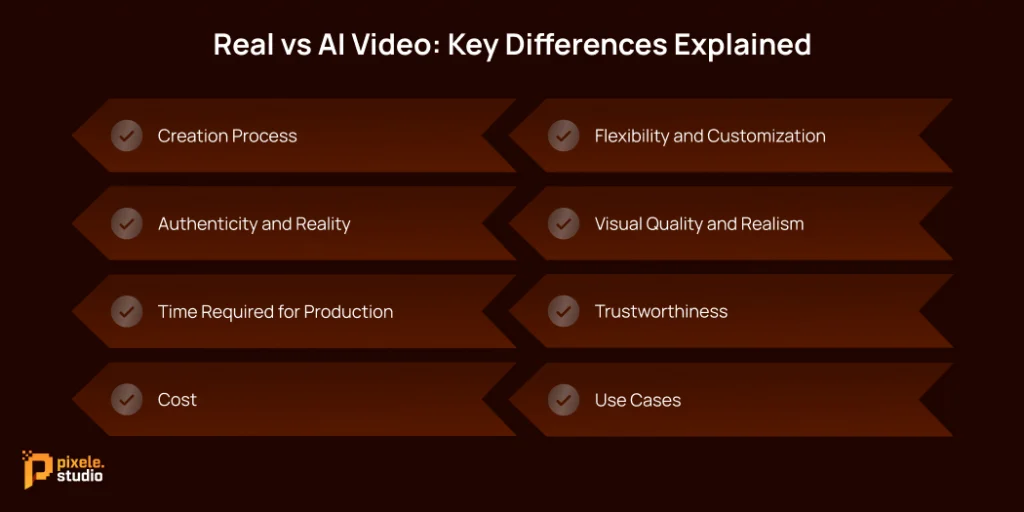
Even though real and AI videos can look very similar, it’s important to know the difference in AI video vs real video. The main differences are how they are made, how real they feel, and how much you can change or edit them.
Creation Process
Real videos are created by filming a scene in real time with cameras, actors, lighting, sound recording, and a physical environment. This requires recording live action in physical space.
AI videos are created with computer programs using artificial intelligence algorithms for completely new or modified video content. The AI generates video content based on input like scripts, images, or text prompts. No cameras or live actors are needed.
Authenticity and Reality
Real videos show actual events, so everything you see is real. The actions, emotions, and surroundings are genuine.
AI videos can look very real, but they are made by computers. They can show things that don’t exist in real life. This means AI videos can be convincing, but they are not truly real.
Time Required for Production
Creating real video usually takes a lot of time. Shooting, editing, and post-production can take days or even months, depending on the project.
AI videos are faster because the software can generate scenes quickly. Some complex AI videos may take a bit more time, but overall, they are much quicker than real filming.
Cost
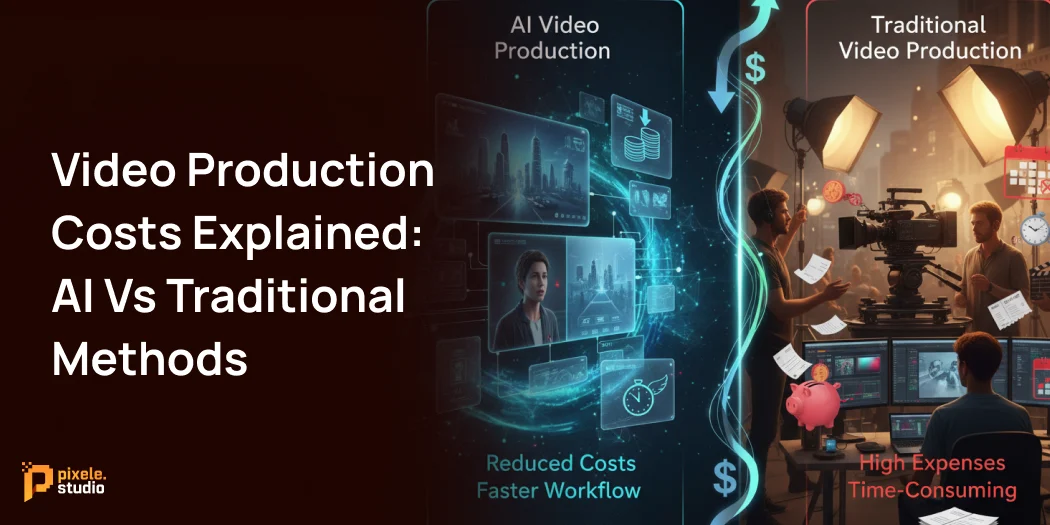
Real videos can be expensive because they need cameras, actors, locations, sets, and editing.
AI videos are usually cheaper because you only need the software and computing resources. There is no need for a full production team, which saves a lot of money.
Flexibility and Customization
Real videos can only show what is real. To change a scene, you have to film it again or pay a lot for changes.
AI videos are more flexible. You can change people, remove backgrounds, add AI avatars, and make changes fast and cheap. You can even make new scenes without starting over. This makes AI videos very easy to use for different things.
Visual Quality and Realism
AI videos look much better now, but real videos still have an edge. AI can create amazing effects and details, even things you can’t do with regular filming.
However, real videos often feel more natural. They capture real textures, light, and human emotions better, which makes them seem more authentic. AI is getting closer to this realism, but making something truly lifelike is still a challenge for it.
Trustworthiness
Real videos are usually more trusted because they show real events or people.
AI videos are computer-based, but they can also be trusted if created using reliable and professional apps or software. When choosing the right AI lip sync tools, videos can be accurate, safe to use, and suitable for marketing, education, or other professional purposes.
Use Cases
Real videos are best for movies, documentaries, ads with real actors, and events where showing real life is important.
AI videos are good for marketing, training, animations, simulations, or situations where filming is too expensive or impossible. They are also useful for creating content quickly for social media or personalized videos.
Pros and Cons of Real Videos
Pros of Real Videos
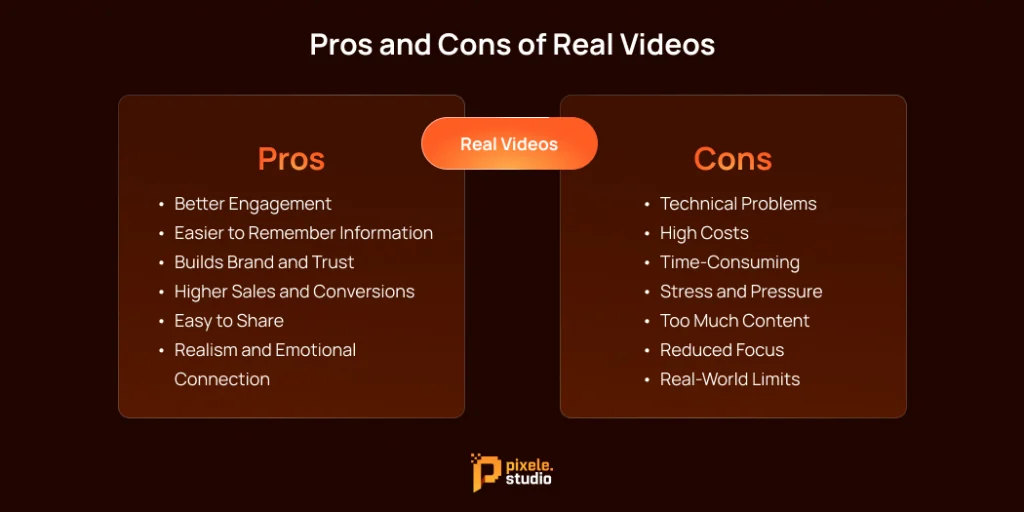
- Better Engagement: Real videos, especially live videos, let the audience interact immediately. Viewers can give feedback in real time, which makes them feel closer and more connected.
- Easier to Remember Information: Watching videos helps people remember information better than reading or listening alone. This makes real videos useful for learning or explaining things clearly.
- Build Brand and Trust: Good video content can increase awareness of your brand and make people trust you more. It shows personality, professionalism, and expertise.
- Higher Sales and Conversions: Videos can influence buying decisions. Showing products or services in action often leads to more purchases and higher revenue.
- Easy to Share: Videos are popular on social media and are often shared, helping your content reach more people and even go viral.
- Realism and Emotional Connection: Live-action videos feel real and authentic, which helps create strong emotional connections with viewers.
Cons of Real Videos
- Technical Problems: Live videos can face issues like poor internet, bad sound, or camera problems that disrupt the viewing experience.
- High Costs: Making real videos, especially high-quality ones, can be expensive. You may need cameras, software, and skilled people to help.
- Time-Consuming: Planning, shooting, and editing videos takes a lot of time and effort.
- Stress and Pressure: Live videos can be stressful because mistakes can’t be easily edited out.
- Too Much Content: There is a huge amount of video content online, making it harder for your videos to stand out.
- Reduced Focus: Fast-paced videos can make people expect instant results, which can make it harder to focus on longer tasks.
- Real-World Limits: Real videos are limited by physical rules and practical situations, so some scenes or ideas can be hard or impossible to film.
Pros and Cons of AI Videos
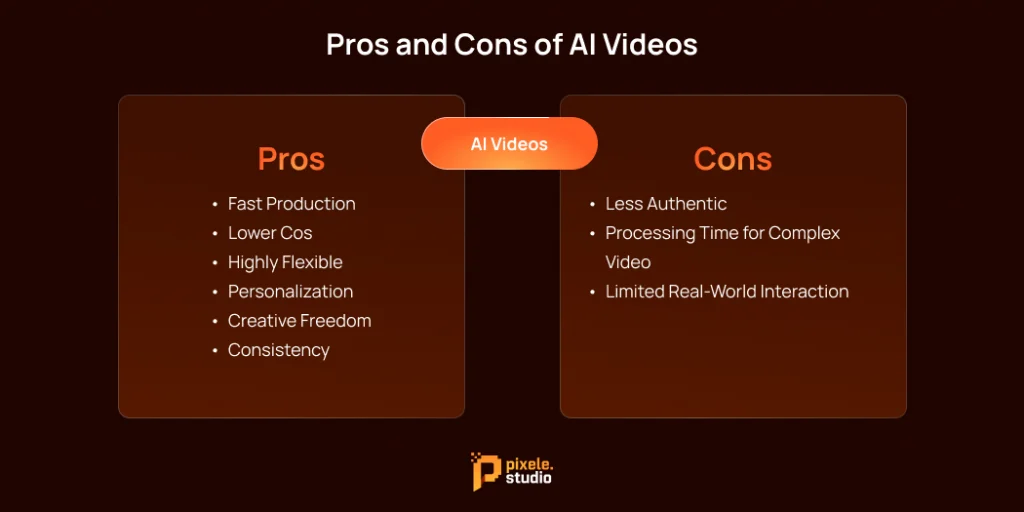
Pros of AI Videos
- Fast Production: AI videos can be created much quicker than real videos. The software can generate scenes, characters, and animations in minutes or hours instead of days or weeks.
- Lower Cost: You don’t need cameras, actors, or locations. This makes AI videos more affordable, especially for businesses or creators who need multiple videos.
- Highly Flexible: You can easily change characters, backgrounds, text, or actions without starting over. You can also create completely new scenes that would be impossible to film in real life.
- Personalization: AI videos can be customized for different viewers or audiences. For example, you can make multiple versions of the same video with small changes for different customers.
- Creative Freedom: AI allows you to make imaginative or animated content, like fantasy worlds, futuristic scenes, or abstract visuals, which are hard to do with real filming.
- Consistency: Once you create a style or template, you can produce multiple videos with the same look and feel, which is great for branding.
Cons of AI Videos
- Less Authentic: AI videos may not feel as “real” as live-action videos. Movements, expressions, or lighting may sometimes look slightly off.
- Processing Time for Complex Videos: While simple AI videos are fast, highly realistic or detailed videos may still take time to process.
- Limited Real-World Interaction: AI videos can’t capture real human interaction, live emotions, or spontaneous events, which real videos can provide.
Quickly turn any photo into a talking video with our AI Lip Sync tool.
AI vs Real Video Test: Can You Spot the Difference?
Here are key tips to help identify whether a video is AI-generated or real by observing common signs:
- Faces and Expressions: In real videos, faces move naturally and expressions change subtly. AI videos may sometimes show unnatural facial expressions, stiff smiles, or movements that don’t quite match the situation.
- Eye Behavior: Real eyes blink and move naturally. In AI videos, blinking may be too slow, too fast, or irregular. The direction of the gaze might also seem slightly off or inconsistent.
- Hand Movements: Hands in real videos move fluidly and naturally. AI-generated hands can sometimes look awkward, stiff, or slightly distorted, especially when doing complex actions.
- Unnatural Actions: AI videos can have small mistakes in movements or physics. Objects may float, people might walk strangely, or motions may seem slightly off compared to real life.
- Mismatched Audio: The voice in AI videos may sometimes not match perfectly with lip movements. It can sound too smooth, robotic, or out of sync in certain moments.
- Lighting and Shadows: Real videos have natural lighting and shadows that match the environment. AI videos can sometimes have shadows in the wrong place or lighting that looks too uniform or artificial.
- Physical Interactions: In real videos, people interact naturally with objects and each other. AI videos may show objects or people passing through each other, missing realistic touches, or behaving in ways that don’t follow real-world physics.
Conclusion
AI isn’t here to replace real video. Instead, they’ll work together. AI will be a huge help for filmmakers, making post-production easier, creating cool visual effects, and bringing big ideas to life on a smaller budget. Real video will still be best for showing true emotions and human connection.
For creators and businesses, the trick is knowing when to use which. Choose the right tool, and you can tell more powerful stories, connect better with your audience, and achieve amazing things in video.
Frequently Asked Questions
Real videos are filmed with cameras and show real people, events, or places. AI videos are made by computers and can create people, actions, or scenes digitally.
AI videos can look very real and are good for fast and creative content. Real videos feel more natural and capture real emotions, making them better for trust.
Yes, AI videos can be trusted if made using good apps or software. But real videos are usually more trusted because they show real events.
It depends on your goal. Real videos are best for authenticity, emotions, and trust. AI videos are best for speed, creativity, flexibility, and saving money.
AI videos are faster and cheaper to make, easy to customize, and don’t need filming equipment or locations.

Shantilal Materiya is the Founder & CEO of Tagline Infotech, driving innovation in AI-powered software solutions and helping businesses embrace the future of digital transformation services.